01
What is RNA?
RNA (ribonucleic acid) is a biological molecule made from nucleotides. Its sequence and ability to fold into specific structures are central to many biological processes.
UMFold is a research algorithm for RNA tertiary structure prediction, developed with a focus on computational optimization and parallel computing.
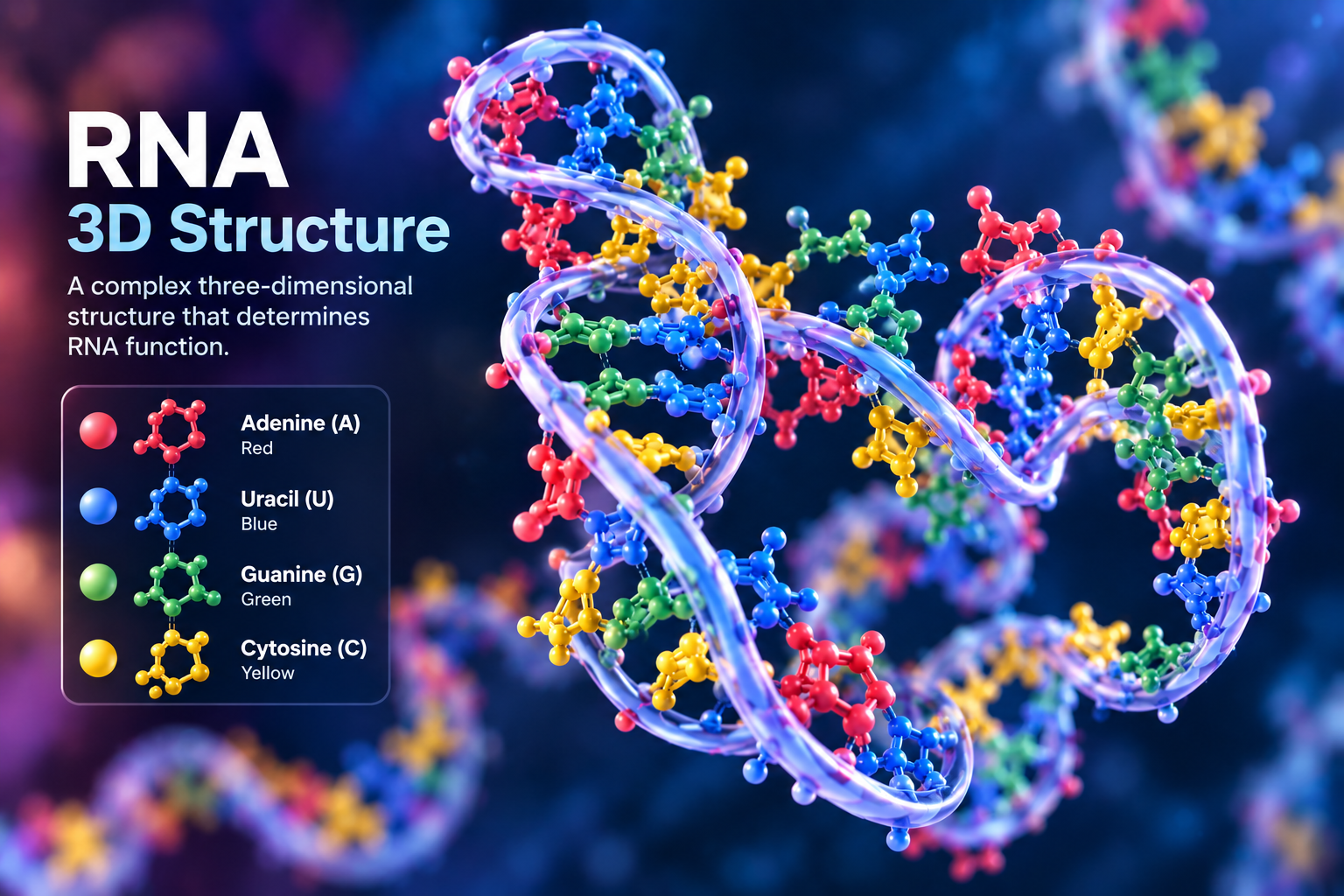
RNA function is closely connected to molecular structure. UMFold investigates a computationally optimized approach for predicting RNA tertiary structures, with particular attention to longer sequences and execution time.
RNA can be understood at several structural levels. The sequence provides the molecular information, secondary structure describes important base-pairing patterns, and tertiary structure represents the final three-dimensional folding of the molecule.
RNA (ribonucleic acid) is a biological molecule made from nucleotides. Its sequence and ability to fold into specific structures are central to many biological processes.
The primary structure is the linear nucleotide sequence of an RNA molecule. It records the order of its bases—adenine (A), uracil (U), guanine (G) and cytosine (C).
The secondary structure describes how nucleotides pair and form structural regions such as hairpins, loops, bulges and stems. UMFold uses the corresponding dot-bracket secondary-structure information as part of its input.
The tertiary structure is the complete three-dimensional arrangement produced when the RNA folds in space, including interactions between structural regions. UMFold predicts this 3D structure in PDB format.

Academic researcher working across bioinformatics, computational optimization, parallel algorithms and high-performance computing.
RNA structure is closely connected to its biological function. Predicting the tertiary structure computationally becomes particularly challenging as RNA sequences become longer and the structural search becomes more computationally demanding.
The research identifies a practical need to work with RNA sequences much longer than the limits reported for several existing prediction approaches.
RNA tertiary-structure prediction can require substantial computation. The research therefore focuses on reducing execution time and using computational resources efficiently.
UMFold was developed as a computationally optimized approach for tertiary-structure prediction, followed by parallel execution on shared-memory multicore architectures.
UMFold takes primary sequence and corresponding secondary-structure information and constructs a predicted RNA tertiary structure in PDB format.
Hairpin, internal, bulge, stack, single-stranded and multi-loop regions are considered during structural analysis.
Candidate structural regions are searched against PDB metadata and the configuration with the highest similarity is selected.
The tertiary interaction procedure uses dynamic programming with a slight divide-and-conquer approach, followed by parallelization.
Parallel computing is a central part of the UMFold research. The algorithm was implemented on shared-memory multicore architectures to accelerate computationally intensive stages of RNA tertiary-structure prediction.
After tertiary interactions are identified, candidate loop subsequences must be searched against approximately 2,753 PDB Meta files. The research identifies this search and the subsequent construction of the tertiary PDB file as the most time-consuming procedures.
Loop subsequences are distributed across available processors to find matching structural regions and their similarity values.
Matching PDB data associated with different PDB IDs is processed in parallel to construct the resultant tertiary structure.
A UniquePDBID vector helps avoid repeatedly loading the same PDB file when multiple loop-similarity results refer to it.
The documented implementation uses OpenMP dynamic scheduling with a chunk size of 100 for the PDB Meta-file search.
The sequential workflow is retained while selected computationally expensive portions are parallelized. OpenMP creates worker threads, distributes suitable loop iterations among processors, and joins the results before the next stage of the algorithm.
For experiments on sequences extending to approximately 10,000 nt, the thesis reports about 7.37× speedup on a 28-core machine.
The applications below are grounded in the scope and experiments described in the research—not claims of clinical or commercial deployment.
Computational prediction for longer RNA sequences, with experiments reported up to approximately 10,000 nucleotides.
Computational analysis of long RNA sequences relevant to viral RNA research.
Connecting secondary-structure information with computationally predicted tertiary structures.
Analysis of structural regions and possible interactions such as pseudoknots and kissing hairpins.
Demonstrating shared-memory parallel techniques for computationally intensive RNA analysis.
Generation and evaluation of RNA 3D structures using structural databases, similarity and RMSD analysis.
Reported experimental results demonstrate both structural evaluation and computational performance.
The thesis reports RMSD values below the stated permissible value of 6.
Research publications and academic contributions associated with Mrs. Ujjwala Hemant Mandekar.
Ujjwala H. Mandekar
Explores an evolutionary-algorithm-based approach to register allocation for embedded systems, focusing on efficient assignment of processor registers during compilation.
Research paperUjjwala H. Mandekar · S. P. Khandait
Presents computational work on predicting the three-dimensional structure of RNA, contributing to the broader problem of RNA structural modelling.
Journal paper · RNA / BioinformaticsUjjwala H. Mandekar · Leena Patil · Sunanda Khandait
Describes an approach for RNA tertiary-structure prediction that uses parallel computation to improve the execution of a computationally intensive structural-analysis task.
Journal paper · RNA / Parallel ComputingUjjwala Hemant Mandekar · Sunanda P. Khandait · Leena H. Patil
Focuses on computational optimization and parallel algorithms for functional bioinformatics, closely aligned with the research direction behind UMFold.
Journal paper · Bioinformatics / HPCUjjwala H. Mandekar · Sunanda Prabhakar Khandait
Presents UMFold as an algorithm for RNA tertiary-structure prediction, describing the computational approach developed for structural modelling.
Book / research chapterVijaya P. Balpande · Ujjwala Hemant Mandekar · Pravin B. Pokle · Ajay M. Mendhe · M. G. Pathan
Examines the integration of machine learning with Process Analytical Technologies (PAT) in the food industry, connecting data-driven methods with process monitoring and analysis.
Journal paper · AI / Food TechnologyRupali Atul Mahajan · Rupesh G. Mahajan · Manjusha Tatiya · Ujjwala Hemant Mandekar · Minal Shahakar · Yogendra Patil
Addresses MQTT security in Internet of Things environments and proposes an enhanced symmetric-algorithm approach for improving message-security protection.
Journal paper · IoT / SecurityUjjwala Mandekar · Vijaya P. Balpande · Pradnya Borkar · Pooja B. Aher
Introduces the architectural concepts underlying high-performance computing systems and provides an academic overview of HPC architectures.
Book chapter · HPCPradnya Borkar · Sagarkumar Badhiye · Ujjwala Mandekar · Vijaya P. Balpande · Roshani Raut · Pratik Agrawal
Covers high-performance computing use cases, APIs and application-oriented aspects of developing solutions for HPC environments.
Book chapter · HPCVijaya P. Balpande · Ujjwala Mandekar · Pradnya Borkar
Introduces techniques used to parallelize computational workloads, complementing the researcher's broader work in parallel and high-performance computing.
Book chapter · Parallel ComputingPradnya Borkar · Vijaya Parag Balpande · Ujjwala Hemant Mandekar · Sthitipragyan Biswal · M. Karthikeyan
Explores the use of weather sentiment and quantum graph networks for intraday stock-prediction modelling, combining alternative data with advanced computational learning methods.
Research article · AI / Quantum Graph NetworksPublication metadata should be treated as a curated website list; the Google Scholar profile remains the authoritative external source for the live publication record.
Mrs. Ujjwala Hemant Mandekar is an academic and researcher whose work connects computer science with bioinformatics, computational optimization and parallel computing.
Lecturer, Government Polytechnic Nagpur, Maharashtra, India
Her research journey includes the development of UMFold, a computational approach for RNA tertiary structure prediction with emphasis on computational optimization, structural similarity and execution on shared-memory multicore architectures.
B.E. — Computer Technology
Chandrapur Engineering College, R.T.M. Nagpur University · 1999
M.Tech. — Computer Science & Engineering
G.H. Raisoni College of Engineering, R.T.M. Nagpur University · 2009
Ph.D. — Computer Science & Technology
R.T.M. Nagpur University · 2021
Ph.D. — Computer Science & Technology
R.T.M. Nagpur University · 2021
Doctoral research at Priyadarshini Institute of Engineering and Technology on “Computational optimization and analysis of functional bioinformatics structures using parallel algorithm”, under the guidance of Dr. Sunanda P. Khandait.
The completed doctoral research led to the development of a method for RNA tertiary structure prediction and the UMFold research work presented on this website.
Lecturer
Started academic career at Priyadarshini Polytechnic, Nagpur.
Head, Computer Technology Department
Promoted to departmental leadership at Priyadarshini Polytechnic, Nagpur.
Assistant Professor
Joined Priyadarshini J.L. College of Engineering, Nagpur.
Government service
Joined a government organization through MPSC selection.
Lecturer
Government Polytechnic Nagpur, Maharashtra.
For academic enquiries, collaborations or further information about the research, please use the appropriate institutional contact channel.